Copper is one of the most basic metals used in industry. It is heavily used in the construction, electrical appliances, automotive, electronics, energy generation sectors and renewable energy sectors. Copper price is considered a proxy for economic activity. Factors influencing copper price include mining supply, world stocks, economic growth, currency, trade policies and geopolitical factors.
In the last month (mid-Oct to mid-Nov 2026) copper prices have corrected. This is as a result of higher stock-piles, uncertainty with US trade policies, fears over economic growth globally and demand changes. However, there remains supply issues with demand growth coming from the electric vehicle, renewable energy and data centre sectors providing support.
Copper Prices Witness a Significant Correction
In the last month we have seen a decline in copper prices. After October where Copper prices were at high levels, closing at around US$14,635 per tonne on October 14th on the LME three-months contract, they remained fairly stable at around US$14,484 per tonne on October 28.
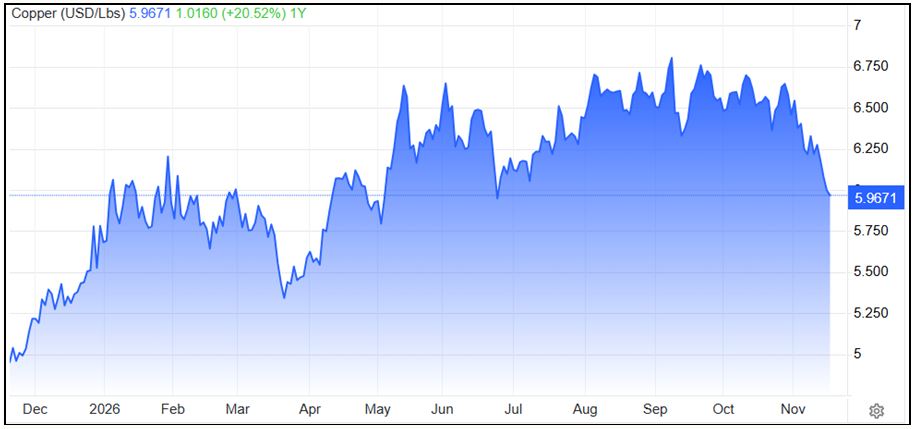
However, negative sentiment increased over November and by November 12 prices on the LME three-months contract had fallen to around US$13,655 per tonne. This was a drop of almost 6.7% from the October 14 price. This was due to new investor expectations about world demand, trade and metal supply.
This shows how sensitive industrial commodities can be. Whilst copper has great demand potential in the long term there is still uncertainty in the short term.
US Trade Policies and Tariff Uncertainty
Uncertainty regarding US trade policy has been a major factor affecting copper prices. Earlier in 2026 expectations of potential tariffs on imports of refined copper prompted large volumes of copper to be brought into the country. This caused a premium in US contract price and diverted supply away from international sources.
However, expectations have changed in relation to the proposed tariffs. After the US mid-term elections on November 3rd market players have reconsidered the potential for further tariffs on imported refined copper. As there are now expectations that there may be delays to the proposed tariffs, the price has been hit.
As the premium between COMEX and LME has fallen, less incentive for bringing more copper into the US has occurred. This has caused selling in international markets.
Rising Copper Inventories Add Pressure
A further factor that has contributed to this recent correction is the growing surplus of copper in LME approved warehouses. Generally speaking, higher metal surpluses can signal better short term availability and therefore cause pressure on the price of copper.
The LME inventory figures show that copper stocks rose from around 228,000 tonnes on October 14th to 328,600 tonnes by November 12th. This is a rise of nearly 44%. This was an indication of changes in the flow of metal across the globe.
This caused some relief to those who were concerned over potential short term shortages. Increased stocks in warehouses means that there will be more metal available for short term consumption. This can therefore cause less interest for traders to buy and put downward pressure on the price. Inventory levels became an important indicator for market participants to determine the direction of price.
US Dollar and Interest Rate Expectations
Copper was also impacted by developments in the US Economy and Monetary Policy. As copper is a globally traded commodity it is traded in US dollars meaning any movement in the dollar will have an impact on price. During periods where the dollar strengthens this can cause price increases for copper as those buying the commodity are paying in different currencies.
Expectations of monetary policy from The Federal Reserve were an important factor during this period. Concerns over inflation meant that there was a lot of caution within the market.
Higher interest rates increase borrowing costs for businesses and consumers. Increasing costs may impact on investments into sectors of the economy such as Construction. Infrastructure and Manufacturing which make up a large percentage of global Copper consumption. This will have a negative impact on demand for industrial metals.
China’s Industrial Demand Remains Important
China is very important when looking at world demand for copper as it is the biggest consumer. Its construction industry, manufacturing, infrastructure and electrical equipment account for a large part of global consumption.
Over the past month, there have been some concerns about China’s economic recovery. If there is less investment in property, manufacturing or infrastructure then less copper will be consumed.
However, government investment into infrastructure, support in industry and investment in renewable energy can boost consumption. Investors are closely watching the manufacturing industry, construction industry and how much stimulus China is implementing to see how the price of copper will move.
Supply-Side Challenges Provide Long-Term Support
Despite recent setbacks, copper still faces supply-side headwinds. Mining issues, operational, labor and ore grades will cause issues with global supplies.
Major producing countries such as Chile and Peru are key producers of copper. If there are any issues with mining in these areas it may cause a decrease in copper concentrate.
New copper mines require large amounts of investment, approvals and take several years to develop. This means that there is limited ability to increase production quickly to meet increases in demand. This means that supply issues are a key long term factor to consider when investing in copper.
Growing Demand from Electric Vehicles and Renewable Energy
There is an optimistic outlook for demand for copper in the long term due to the global move to clean energy. Electric vehicles use large amounts of copper in batteries, motors, electrical wiring and charging infrastructure. Renewable energy infrastructure, such as solar and wind farms also use a lot of copper.
Expansion of electrical infrastructure will also drive copper consumption. Many governments are investing in the renewable energy sector, electric transport and electrical infrastructure.
Fast growth in artificial intelligence and data centres is also a new driver for copper demand. These facilities use lots of electrical infrastructure, power distribution and cooling. They can be major drivers for industrial copper consumption in the future.
Outlook: What Lies Ahead for Copper Prices?
Moving forwards we expect copper to be driven by global macroeconomic conditions, US trade policy, inventory changes and industrial demand (particularly from China). Rising inventories, a higher USD and fears of slowing manufacturing may lead to some short term pressure
Improving Chinese industrial demand, higher infrastructure spending or new supply issues could provide a boost. Investors will be looking at how developments in electric vehicle production, investments into renewables and expansion in electricity infrastructure globally.
Monitoring LME/COMEX inventory levels, USD movements, mining output and manufacturing numbers globally will be key in understanding the way the price will move.
Conclusion
Copper has had a tough month as it has corrected due to high inventories, uncertainty around US trade policy and worries about global economic growth. This has been exacerbated by changing interest rate expectations and industrial demand. However, in the longer term copper fundamentals are positive due to increasing demand from electrification, renewable energy, EVs and increased data centre infrastructure. Although there may be some short-term volatility, it will be an important commodity to look at going forward with the world becoming more reliant on electricity, modern infrastructure and clean energy.