Crude oil stayed one of the closely watched commodities in September 2026 because of geopolitical tensions, supply issues and uncertainty about global energy trade. These factors had an impact on prices. The month saw an increase in crude oil prices with Brent crude going up about 14% and West Texas Intermediate (WTI) crude increasing roughly 5%. The rise showed worries about oil supplies from the Middle East especially because of the ongoing conflict between the United States and Iran. These events showed how important crude oil is for inflation economic growth and financial market mood. For India, which buys an amount of crude oil changes in international prices have a big effect on the economy and, on investors
How Did Crude Oil Prices Move During September?
International crude oil prices showed swings during September. At the start of the month worries about oil supply were already shaping how people felt about the market. As political tensions grew prices jumped sharply on September 9 Brent crude went above $100 per barrel and ended the day at $101.21. The day on September 10 both Brent and WTI climbed even higher closing at $107.63 and $102.48 per barrel after more attacks on ships and fears that oil transport could be interrupted. These moves showed that the risk added to oil was rising because people were unsure, about future supply.
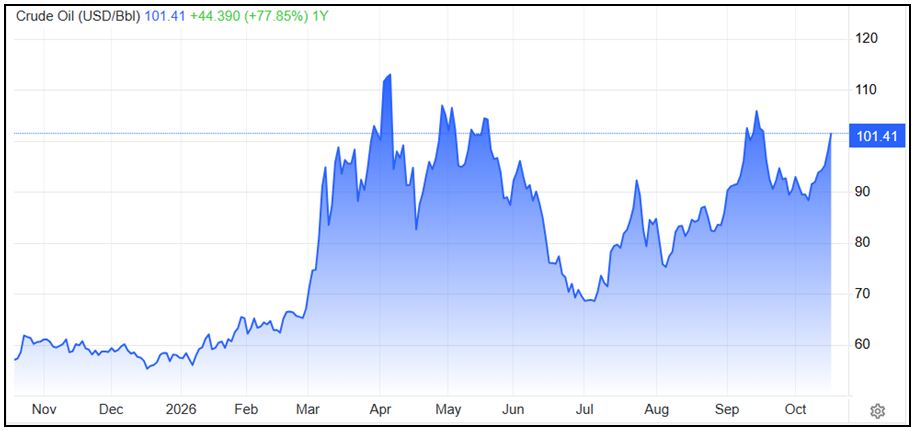
By September 30 Brent crude futures ended at $103.50 per barrel. This showed a gain of about 14 percent. WTI crude finished at $90.42 per barrel. This meant a rise of 5 percent, for the month. Even though prices went up and down the general direction was still upward. Traders kept looking at events and the chance that supply problems might last longer.
Geopolitical Tensions Drive the Rally
One of the reasons for the increase in crude oil prices was the ongoing conflict between the United States and Iran. The Middle East plays a role in global oil production and exports. That makes the region very important for energy markets. When there is any threat to oil production sites, pipelines or shipping routes it raises worries about whether there will be crude oil available, around the world.
The Strait of Hormuz is very important because a large part of the world’s oil that moves by ship usually goes through this sea passage. In September there were attacks on ships. The situation became more tense, with military activity, which made people worried about oil tankers moving through the area. Because of this traders thought that there might be oil available and that it would cost more to transport.
When geopolitical uncertainty increases oil prices can climb before a major shortage shows up in official production data. This happens because buyers and traders must try to cover the risk of supply disruptions. In September uncertainty about talks between Washington and Tehran stopped the market from fully regaining its confidence, in the stability of energy supplies. Oil prices continue to feel the effect of uncertainty
Supply Disruptions and Global Oil Availability
The International Energy Agency (IEA) in its September 2026 Oil Market Report said the global supply situation is very serious. The report said that global oil production fell by 1.6 million barrels per day in August to about 100.1 million barrels per day. Than 10 million barrels per day of Gulf oil output stayed shut because of higher security risks. The agency also said that global oil supply could fall by 5.7 million barrels, per day during 2026 and that the full return of Middle Eastern production might be delayed until 2027.
These changes put pressure on prices. Prices rose because the market had supplies that could absorb unexpected disruptions. Prices also edged higher when freight costs climbed, shipping risks grew and global oil inventories fell. These factors made people worry more about the balance between demand and supplies.
However markets felt relief when exports from parts of the Gulf region started to recover. Saudi Arabia reopened oil shipments through its Red Sea port of Yanbu. That helped improve the flow of oil even though uncertainty, around the Strait of Hormuz remained. This export recovery eased supply concerns a bit. Caused prices to swing during the final days of September.
Global Demand and the Economic Outlook
Supply disruptions have pushed prices higher.. I still worry about global demand. Rising energy costs can make households and businesses use fuel or postpone activities that need a lot of energy. Higher transportation and manufacturing costs can also make the economy feel weaker
In its September report the IEA predicted that global oil demand would drop by 2.5 million barrels per day in 2026. The agency said this weaker outlook was partly due to supply disruptions, high fuel prices and uncertainty about the global economy. It also said that global oil demand might bounce back by 2.6 million barrels, per day in 2027
This made two forces in the market. Political conflicts and less supply helped push crude oil prices but worries about lower demand stopped prices from going up a lot. Because of this traders watched carefully what happened with politics how much oil was being made and numbers, about the economy to figure out where prices might go next.
Impact of Rising Crude Oil Prices on India
India is especially sensitive, to crude oil movements because India uses a lot of imported petroleum to meet its energy needs. When global oil prices rise India may have to spend foreign currency on oil imports, which can widen India’s trade deficit and put pressure on the Indian rupee.
Higher crude oil prices can raise transportation costs, logistics costs and manufacturing costs. I notice that if businesses transfer these expenses to consumers inflationary pressures may climb and crude oil prices will keep pushing them up. Industries that rely heavily on petroleum products, for materials or fuel can face higher operating costs and lower profit margins
The effect can also reach government budgets. Depending on how fuel costs at home, taxes and other government rules if crude oil prices keep going up governments will feel pressure to find a balance, between keeping people able to buy things and still earning enough money.
For investors crude oil is a sign of the economy. When prices stay high for a time they can change what people expect about inflation how money moves what banks decide about interest rates and how much companies make money in many fields.
Which Sectors Are Most Affected?
The effect of changes in the price of oil is different for different industries. Companies that explore and produce oil can gain when the price of oil goes up because they can sell their oil for more money, which helps their income.. How much they actually gain depends on how much it costs them to produce the oil and other things.
On the hand companies that fly planes often have higher costs because the fuel they use is a big part of their expenses. Industries that make paint, chemicals, tires and other products made from oil can also have trouble with profits when the cost of the materials they need goes up. Companies that sell oil products can also have problems if the cost to buy the oil goes up faster than the price they can sell it for.
If the price of crude oil goes down it can lower the costs for many of these companies and make them more profitable. Investors should look at how each company’s affected by changes in the price of crude oil instead of thinking that all companies will react the same way to the same change, in price.
Conclusion
In September 2026 geopolitical tensions and supply disruptions showed how much crude oil prices can change. Brent crude jumped 14% in the month and WTI climbed about 5% because uncertainty about Middle Eastern oil supplies kept market mood high. Even though export flows grew the global energy market stayed at risk for disruptions.
For India long‑term high crude oil prices can raise import costs add to inflation pressure and hurt profits in many sectors. Knowing how crude oil, currency changes, inflation and company earnings connect is therefore key, for investors. By watching market data and checking the basic economic factors investors can see the chances and dangers that come from shifting crude oil prices.