While gold and silver performed very well in 2026, they have both seen significant losses recently. In January, both gold and silver prices hit record levels, due to demand for safe havens, geopolitical tension, optimism around monetary loosening and increased investor activity. Since this time however, market conditions have changed significantly. With rising US treasury rates, an appreciation in the value of the dollar, changes in expectations around interest rate changes at the Federal Reserve and large profit taking, gold and silver have fallen sharply. Silver has seen sharper losses than gold.
Gold Prices Decline Over ₹57,000 from January Peak
Prices of Gold have seen bullish momentum in January 2026 with MCX Gold futures hitting their highest level till date at ₹1,80,501 per 10 grams on January 29. However, due to changing macroeconomic conditions, the price of gold began correcting. On November 20, 2026, December gold futures were trading around ₹1,22,561 per 10 grams.
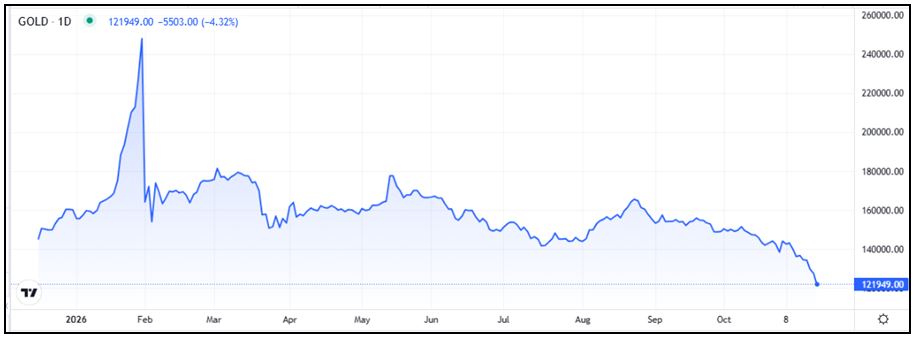
This declined by around 3.84% over the course of the day. Since reaching their peak in January, gold prices have corrected by around ₹57,940 per 10 grams or 32.1%. This correction was driven by shifting interest rate expectations, appreciation in the USD and profit taking following the huge rise in gold prices. Therefore, we can see that even safe haven assets like gold have had significant volatility in response to changes in global financial conditions.
Silver Witnesses a Steeper Correction of Nearly 65%
The price of silver has fallen significantly more than gold. Silver futures on MCX reached a peak value of Rs. 4,07,456 per kg on January 29, 2026, but further trading resulted in silver reaching an all time peak of Rs. 4,20,048 per kg. However, the increasing selling pressure caused a reversal in the trend.
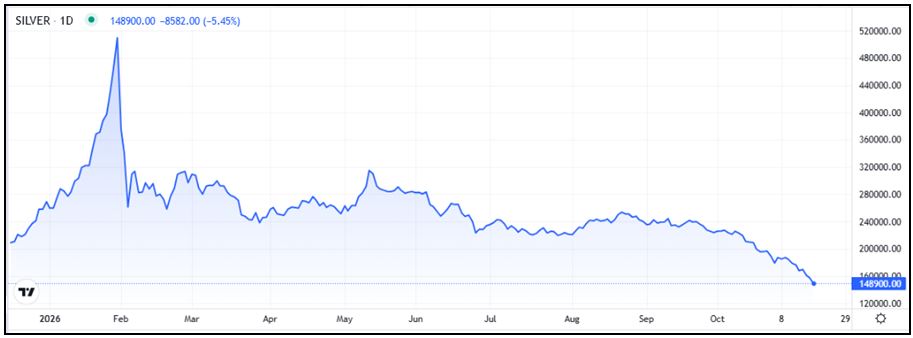
On November 20, 2026, December silver futures fell to Rs. 1,48,050 per kg. That is a drop of almost 5.99% within that day. Comparing this figure with the all-time peak of silver prices in January, the price of silver has dropped by approximately Rs. 2,71,998 per kg. This amounts to a correction of roughly 64.8%. This significant fall in prices shows that silver is much more volatile based on investor sentiment, industrial demand and broader commodity prices.
Gold vs Silver: Comparing the Price Correction
Comparing the two, gold prices have fallen to 32.1% from their peak levels in January, while silver prices have fallen more drastically by around 64.8%. Prices of gold have fallen by around ₹57,940 in 10 gms, while silver prices have fallen by around ₹2,71,998 in 1 kg. Gold has a strong support from Central Bank demand, investment demand as well as safe haven properties. Silver on the other hand is driven by investment demand and industrial demand. Hence, silver has seen greater price volatility than gold in times of fluctuating market sentiments.
Why Are Gold and Silver Prices Falling?
Expectations around US Federal Reserve monetary policy have changed and caused the recent correction. Inflation fears have been rising in recent times and the Fed has signalled a more hawkish stance. As gold and silver do not produce interest, if interest rates rise, gold and silver prices are generally less attractive to investors. This can cause increased selling pressure upon precious metals as investors move into interest bearing assets. Therefore, expectations of fewer interest rate cuts, or in fact further tightening, are important factors affecting bullion prices.
| Particulars | Gold | Silver |
| January 2026 peak | ₹1,80,501/10g | ₹4,20,048/kg |
| November price | ₹1,22,561/10g | ₹1,48,050/kg |
| Absolute decline | ₹ 57,940 | ₹ 2,71,998 |
| Percentage decline | 32.10% | 64.80% |
Finally, the US dollar has been appreciating and US treasury yields have increased. Given that Gold and Silver are traded in USD, investors looking to buy these commodities may find them more expensive if they are investing in USD. This has therefore reduced demand for Gold and Silver globally. In addition, increasing yields mean that investors are facing a larger opportunity cost if they invest in non yielding assets. As a result, investors have lost interest in investing in precious metals recently.
Furthermore, profit-taking has occurred within these metals. Due to global uncertainty, trade worries and anticipated easing, significant investments were made in both metals. After hitting record highs, however, profit taking began to occur, causing downwards pressure. This was compounded by position unwinding and technical selling in the market. Silver has generally experienced more volatility than gold and so has seen a sharper correction.
Industrial Demand Concerns Add Pressure on Silver
Silver is highly dependent on industrial activity. It is used in solar technology, electric vehicles, electronics and many more industrial processes. Therefore, any slowdown in industrial activity or uncertainty of future industrial demand can impact demand for silver. Uncertainty over the growth rate of the renewable energy and electronics industries may also mean investor sentiment is impacted. However, although there are clear fundamentals in industrial demand in the long run, uncertainty over current economic activity and positioning of investors in the short term means that silver has fallen much further than gold.
Impact of Global Inflation and Crude Oil Prices
The energy market also has implications on precious metals. Higher crude oil prices increase costs associated with both production and transport. As a result, there is more inflation within the economy. If higher inflation continues, central banks may be less inclined to lower interest rates, therefore causing tighter monetary conditions to continue to be in place. In general, non-yielding assets such as precious metals are unlikely to perform well within this situation. Therefore, crude oil prices, inflation figures and central bank actions are important indicators for gold and silver investors to consider
Impact on Indian Investors and Domestic Bullion Prices
Prices of precious metals in India do not necessarily follow the same trend as the world market. In addition to the world market, factors such as exchange rates, import duties, taxes and local market premiums will influence prices in India. If the Indian Rupee falls against the US Dollar then it can compensate for a decrease in world bullion prices as the cost of importing bullion into India increases. However, government import duties and demand in India (during festive periods and weddings) can also impact local bullion rates. As such, investors in India should consider both world price trends alongside domestic market factors.
Outlook: What Should Investors Watch Next?
Gold and silver are likely to be influenced in the short term by interest rate policy from the US Federal Reserve, USD movement, Yields in Treasuries and inflation globally. If we start to see higher interest rates this could put pressure on precious metals, however if we see lower inflation, lower bond yields and increased geopolitical uncertainty then this could provide support. For silver industrial demand has picked up, in particular from solar, EVs and electronics. Gold may also continue to benefit from buying by central banks and safe haven demand in times of economic uncertainty.
Although we have seen a steep correction in both markets, it is still difficult to determine when the bottom of the market will occur. Before investing further in gold and silver, investors should consider the level of risk they are willing to take, how long they can invest for and what proportion of their portfolio they wish to invest. The next few months will give insight into whether we are seeing a short term correction or longer term adjustment in precious metals.