Options trading is often seen as risky full of guessing and focused on changes in the market.. Options can also be part of a careful plan that helps make money and get good stocks at a price you like. One such plan is the Cash-Secured Put. It is an options plan used by people who think a stock will go up or maybe just not go down too much. These investors are okay with owning the stock if the price drops to a point they choose ahead of time.
The main idea of a Cash-Secured Put is easy to understand. An investor sells a Put Option. Makes sure there is enough money set aside to buy the stock if the option is used. As payment for taking that responsibility the investor gets money up front. If the stock stays above the chosen price until the end the option might not be. The investor keeps all the money. If the stock goes below the price the investor might have to buy the stock at the set price, which lowers how much they pay for it because they got the money from the option.
This makes the plan very appealing, for people who want to buy a stock but are ready to wait for a price.
What Is a Cash-Secured Put?
A Cash-Secured Put involves two steps. First the trader sells a Put Option on a stock. Second the trader keeps cash ready to buy the shares if they have to. Selling the Put means the trader agrees to buy the stock at the strike price if the person who owns the option decides to exercise it.
For example imagine a stock is now being sold for ₹1,000 and a person wants to have it but feels ₹950 is a price to get in. Of just buying it directly at ₹950 the person can sell a Put Option with a strike price of ₹950 and get a payment of ₹25 for each share. If the stock goes below ₹950 when the option ends the person might have to buy the shares for ₹950 which makes the total cost ₹925, per share after adding the ₹25 they got as payment.
If the stock stays above ₹950 when the option ends the Put might not be worth anything. The investor keeps the ₹25 premium. If the stock goes below ₹950 and the option is used the investor buys the stock at ₹950. Since ₹25 was received as premium the actual cost to buy the stock is ₹925 per share before considering costs, like transaction fees and taxes.
So the strategy can help in two ways: making money from the premium and possibly buying the stock at a price.
How Does the Strategy Work?
The first step is choosing a stock that the investor would really feel good about owning. This is important because selling a Put is not a way to get money. If the stock drops a lot the trader might end up having to buy the shares.
Once the stock is chosen the investor picks a Put Option strike price. Usually the strike price is set lower than the market price. The investor then sells the Put and gets the premium.
The investor needs to have cash to handle the possible obligation to buy the stock. For a contract the amount needed is usually calculated by multiplying the strike price by the number of shares, in the lot. For example if the strike price is ₹950 and the lot size is 100 shares, the possible obligation to buy is ₹95,000. The investor must have enough money ready to cover this.
The trade can stay open until it expires or it can be handled earlier based on what’s happening in the market.
Example of a Cash-Secured Put
Consider a stock that is priced at ₹1,000. An investor wants to buy the stock. Feels ₹950 is a better price to start. The investor sells one ₹950 Put Option and gets a premium of ₹25. The size of the contract is 100 shares. The amount received as premium is ₹25 multiplied by 100, which’s ₹2,500. The investor makes sure to have ₹95,000 in cash in case they have to buy 100 shares at ₹950.
Now think about three situations. If the stock stays above ₹950 when the option ends the Put option has no value. The investor keeps the ₹2,500 premium, it does not buy the shares. If the stock ends at ₹950 the option could end close to the strike price based on how it is settled. The investors overall result is still based on the ₹950 strike price minus the ₹25 premium. If the stock drops to ₹900 the Put option can be assigned. The investor might have to buy the shares at ₹950 even though the market’s at ₹900. However since the investor already got ₹25 as premium the actual cost per share is ₹925. The investor now owns a stock ₹900 but paid ₹925, which means an unrealized loss of ₹25, per share. This shows an idea: the premium helps, but it does not completely remove the risk of losing money.
Maximum Profit and Maximum Loss
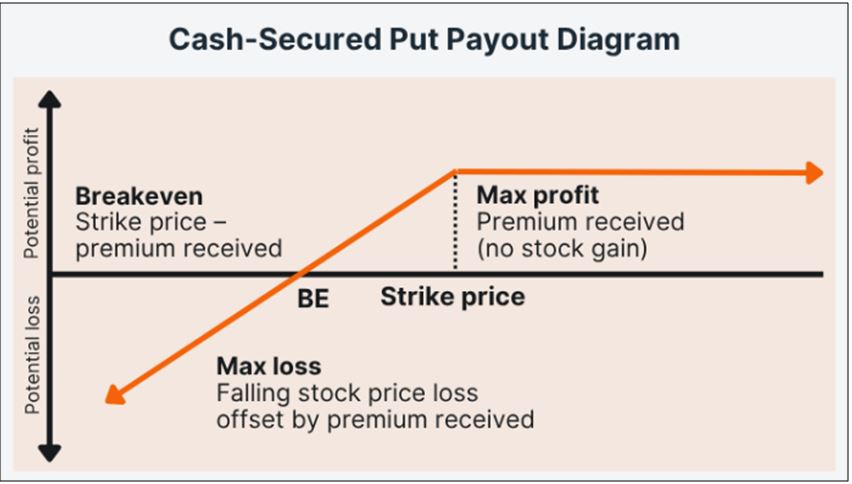
The maximum profit you can get from a Cash-Secured Put is the money you get from selling the option.
In the example we are looking at the investor gets ₹25 for each share. So the maximum profit is ₹25 for each share or ₹2,500 for 100 shares if you hold the position until it expires and do not consider any costs.
The maximum loss can be very big. If the stock price goes down a lot and reaches zero the investor can lose a lot of money which’s the strike price minus the money they got from selling the option.
In this example the price you would pay for the stock is ₹925. If the stock becomes worthless you could lose around ₹925 for each share or ₹92,500 for 100 shares.
This makes a Cash-Secured Put different, from just getting a small amount of money. The potential profit is small. The potential loss can be very big when you use a Cash-Secured Put.
Breakeven Point
The breakeven point of a Cash-Secured Put is calculated by subtracting the premium received from the strike price.
Breakeven = Strike Price − Premium Received
In our example:
₹950 − ₹25 = ₹925
Therefore, ₹925 is the approximate breakeven price. If the stock remains above ₹925 at expiry, the strategy is profitable or at least not loss-making before transaction costs and taxes. Below ₹925, losses begin to emerge. This breakeven calculation is one of the most important factors traders should consider before entering the strategy.
When Should Investors Use a Cash-Secured Put?
A Cash-Secured Put is generally suitable when an investor has a bullish to bullish view on the underlying stock. The investor should ideally believe that the stock will remain above the selected strike price or be comfortable purchasing the shares at that strike. It can also be useful when an investor wants to buy a stock but considers its current market price expensive. Of waiting passively for the stock to decline the investor can potentially earn premium income while waiting.
For example if an investor wants to buy a stock around ₹900. It is currently trading at ₹950 selling a Put, at ₹900 may provide an opportunity to either earn premium or eventually acquire the stock at the desired strike.
However the strategy should not be used simply because an option premium looks attractive. The underlying stocks fundamentals, valuation, volatility, liquidity and overall market conditions should also be evaluated.
Advantages of Cash-Secured Put
One major advantage is the ability to generate premium income while waiting to purchase a stock. If the Put expires worthless, the investor keeps the premium.
Another advantage is the possibility of acquiring the underlying stock at an effective price below the strike because the premium reduces the cost basis.
The strategy can also provide a structured entry approach. Rather than buying a stock immediately at the prevailing market price, investors can define a price at which they would be comfortable buying the shares.
Additionally, the strategy can be useful for investors who have a positive long-term view on fundamentally strong stocks and are comfortable owning the underlying asset.
Risks and Limitations
The biggest risk is a sharp decline in the underlying stock. The premium received provides only limited protection against a large fall.
For example, receiving ₹25 premium does not protect an investor from a ₹200 or ₹300 decline in the stock. Once the stock falls below the breakeven level, losses can increase as the underlying declines.
Another limitation is that the maximum profit is capped at the premium received. Even if the stock rallies sharply, the Put seller generally earns only the premium.
There is also an opportunity cost. If the stock rises significantly, the investor may simply keep the premium instead of participating in the stock’s upside because the shares were never purchased.
Liquidity is another important factor. Options with low trading volume or wide bid-ask spreads can result in higher execution costs and difficulty exiting positions.
Conclusion
The Cash-Secured Put is a relatively straightforward options strategy that combines premium income with a potential stock purchase. It can be useful for investors who are bullish or moderately bullish on a stock and would be comfortable buying it at a predetermined lower price.
The strategy’s key attraction is its flexibility. If the stock remains above the strike price, the investor can potentially retain the premium without purchasing the shares. If the stock falls below the strike, the investor may acquire the shares at the strike price, with the premium reducing the effective cost.
However, the strategy should never be viewed as a risk-free income technique. The maximum profit is limited to the premium, while a significant decline in the underlying stock can result in substantial losses. Therefore, proper stock selection, strike selection, position sizing, implied volatility analysis and sufficient cash management are essential.
For investors who already have a willingness to own a particular stock and want to enter at a lower price, a Cash-Secured Put can be a useful addition to an options strategy toolkit. The key principle is simple: sell the Put only when you are genuinely comfortable owning the underlying asset at the strike price.