The Reserve Bank of India has kept its policy repo rate at 5.25 percent. The RBI is taking an approach to monetary policy because growth, inflation and global economic conditions are changing. The Monetary Policy Committee has chosen to maintain a stance and this decision was made unanimously by the Monetary Policy Committee. The Standing Deposit Facility rate stays at 5.00 percent. The Marginal Standing Facility rate and the Bank Rate stay at 5.50 percent.
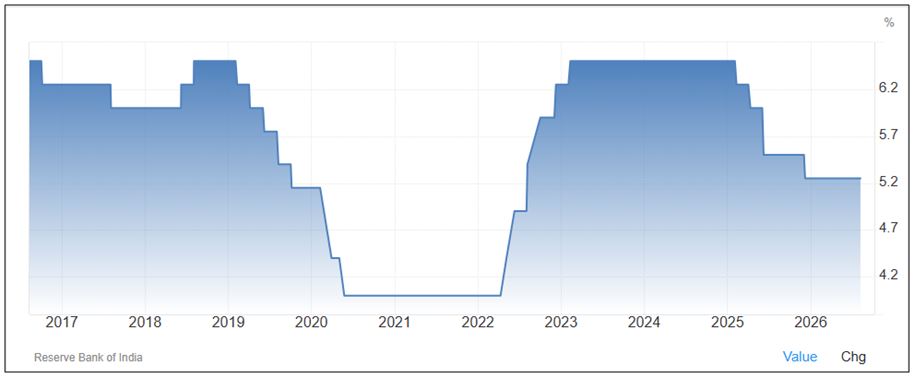
The latest decision shows the Reserve Bank of India is comfortable, with the level of interest rates. The Reserve Bank of India wants to see how earlier policy measures work before they changes rates again. Of cutting rates sharply to boost demand the Reserve Bank of India is focused on keeping macroeconomic stability. The RBI lets economic growth keep moving at a pace.
Why Did the RBI Keep Rates Unchanged?
The repo rate is one of the RBIs important tools in monetary policy. It is the rate at which commercial banks borrow short‑term money from the bank. Changes in the repo rate affect borrowing costs across the economy. These changes influence home loans, car loans, corporate borrowing, deposits and investment decisions.
Keeping the repo rate at 5.25 percent suggests that the RBI thinks the present monetary policy setting is suitable for the current economic environment. The decision also gives policymakers time to see how inflation, domestic demand, credit growth and global developments change.
The RBI already lowered the repo rate to 5.25 percent during the policy cycle. The later decision to keep the repo rate the same shows a shift from rate cuts, to evaluating how well the current policy settings work.
Balancing Economic Growth and Inflation
The RBI’s monetary policy framework revolves around maintaining price stability while keeping growth considerations in mind. This makes the growth‑inflation balance particularly important for the bank.
A lower interest‑rate environment can support activity by reducing borrowing costs and encouraging consumption and investment. However excessive monetary easing can also create pressure if demand grows faster than supply. Therefore the RBI needs to ensure that support for growth does not compromise price stability.
The decision to hold the repo rate suggests that the RBI currently sees merit in maintaining an approach. With the policy rate at a relatively lower level than earlier, in the cycle policymakers can observe how monetary transmission affects households, businesses and financial markets before considering another change.
Impact on Borrowers
For borrowers the choice not to change the repo rate means there will be no quick drop in borrowing costs from the most recent MPC meeting. Current borrowers who have loans tied to benchmarks may find that their interest rates stay largely steady although banks can still make their own adjustments.
Homebuyers and other consumers who plan to take out loans are likely to gain from the somewhat lower interest‑rate climate produced by earlier rate cuts. Lower borrowing costs can make homes affordable and lower the total interest that must be paid over the life of a loan keeping interest rates more manageable for many people.
For businesses steady interest rates give sight for financial planning. Companies can choose to invest and expand with confidence when borrowing costs are fairly predictable which is especially useful for interest‑sensitive sectors, like infrastructure, automobiles, real estate, capital goods and financial services.
Impact on Banks and Financial Institutions
The RBIs decision also matters a lot for banks and financial institutions. When the policy rate stays steady banks can plan their lending and deposit strategies with certainty. If interest rates go down banks might see more people asking for credit. At the time the fight for deposits can push up funding costs and squeeze margins.
So the effect of a repo rate, on a banks profit will hinge on how fast loans grow how deposits are mobilised, the quality of assets and the overall interest‑rate environment. For non‑banking companies or NBFCs the cost of borrowing and how easy it is to get liquidity stay key. A steady policy can let NBFCs map out their funding needs and keep credit growth going.
What Does It Mean for Economic Growth?
Keeping the repo rate at 5.25% can be seen as helping growth because the money conditions are not as tight as they were during the earlier period of tightening. Lower interest rates make it easier for people to borrow and spend. At the time companies find it simpler to fund their capital spending. If credit continues to grow in a way the positive effects can spread across sectors like housing, automobiles, infrastructure, manufacturing and consumer goods.
Monetary policy by itself cannot decide how fast India’s economy grows. Other factors such, as government spending, private investment, exports, household consumption, infrastructure development, productivity levels and global demand will also have an impact. That is why the Reserve Bank of India’s current strategy seems to be letting the existing policy support take effect through the economy of rushing to add more stimulus right away
Impact on the Rupee and Financial Markets
The RBI’s interest‑rate decisions also shape markets, especially the bond market, the currency market and equities. When the RBI keeps the repo rate unchanged it usually cuts the uncertainty because traders already understand the current policy direction.
For the rupee the difference in interest rates between India and other big economies can affect how foreign money moves and how the currency swings. A big drop in interest rates might make Indian assets less appealing to some overseas investors while keeping rates steady can give a bit of support to domestic yields.
In equity markets the effect varies by sector. Sectors that are sensitive to rates, such as banking, financial services, real estate and automobiles can react sharply to changes, in expectations. At the time companies that carry a lot of debt may enjoy a cheaper cost of borrowing when rates fall.
Global Risks Remain Important
India’s monetary policy is influenced by economic developments. Changes in interest rates oil prices, trade conditions, geopolitical tensions and capital flows can affect domestic inflation, the rupee and financial‑market liquidity. India’s monetary policy must account for crude oil prices. In an economy like India crude oil prices are particularly important because India imports a share of its energy. A sustained rise in crude oil prices can raise transportation and production costs. Put pressure on inflation and the current account. At the time changes in global monetary policy can influence foreign portfolio investment flows into Indian markets. The RBI must balance India’s policy, with domestic economic needs and external financial stability.
Outlook: Stability Before the Next Move
RBIs decision to keep the repo rate at 5.25% means a pause in changes to India’s monetary policy. After cuts RBI appears to be looking at how those cuts affect the real economy instead of rushing into another change.
For households RBI’s decision means borrowing conditions will stay relatively stable. For businesses RBI provides certainty about financing costs. For banks and financial institutions the focus will stay on credit growth, funding costs and margins. For investors the main question will be whether inflation stays low enough to let RBI keep or eventually ease RBI’s policy stance.
Ultimately RBI’s challenge is to keep India’s growth momentum going while preventing pressures from returning. The current decision shows that balancing act. With the repo rate at 5.25% and the policy stance still neutral RBI has kept flexibility to react to changing conditions. The path of inflation, growth and global financial markets in the months will decide if the next policy move is another pause or a shift, in the interest-rate cycle.